
From Defence to Dialogue: How to Stay Open When You’re Feeling Challenged
Dec 04, 2025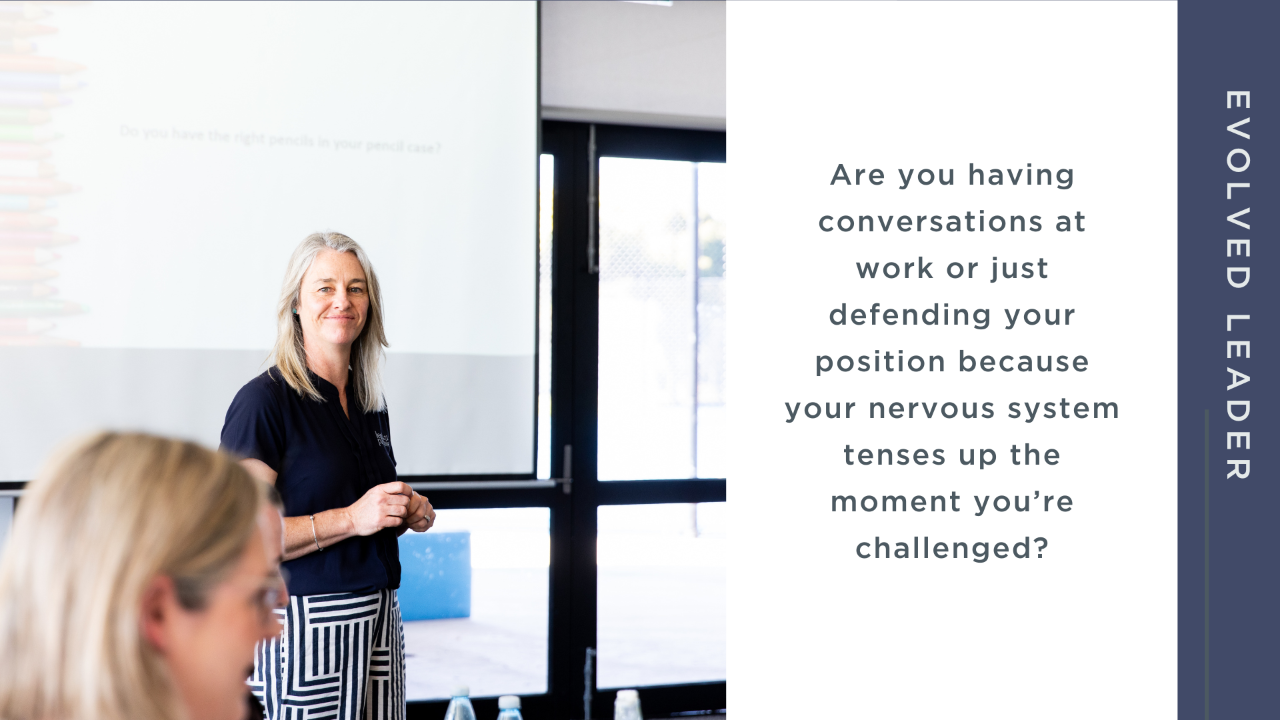
When you’re challenged in a meeting, what happens for you, in your body, in your mind, in your behaviour?
Do you lean in with curiosity, or do you feel your shoulders tighten, your voice harden and your heart rate climb as you gear up to defend yourself?
For many leaders, challenge can feel deeply personal. It can land as a threat to your position, credibility or authority. Even if no one says that out loud, as sson as your brain makes that connection your nervous system often reacts as if your reputation is on the line.
If that sounds familiar, it’s worth pausing to ask:
What’s going on in my environment that might be shaping this reaction?
- Is the culture one where mistakes are punished rather than learned from?
- Are decisions constantly scrutinised, second-guessed or escalated?
- Is there an expectation that leaders “should know” and “shouldn’t be wrong”?
- Are people exhausted, under time pressure, or operating in high risk and uncertainty?
- Are you working in a highly political or competitive environment, where being right feels tied to status, influence or job security?
When we put all of that together, defensiveness starts to make a lot more sense. It’s not that you’re “overreacting” it’s that your brain and body are doing their best to protect you in a demanding environment.
The good news is: once you can see the pattern, in yourself and in your environment, you can start to manage it more deliberately and lead differently in those moments.
So how do you manage your defensive reactions and move back into dialogue
Start with your body. Defence usually shows up in physically before it shows up in your words.
For some people it’s a tight jaw, a raised voice, talking faster or interrupting. Whilst others go internal (quiet), withdraw, or shut the conversation down with short, sharp answers.
Start to get to know your own early warning signs:
- What happens in your body when you feel challenged?
- What happens to your tone and pace?
That moment of self-awareness is your opportunity to choose: react or respond.
Buy yourself a few seconds of space. When you feel triggered, the goal is to create enough space between stimulus and response that you can choose something more constructive.
Its as simple as getting in the habit of taking one slow breath, a sip of water, using a brief neutral statement: “Okay, let me think about that for a moment.” Or taking a look at your notes. It only needs to be a few seconds to break the intensity and give your nervous system a moment to settle just enough for your thinking brain to come back online.
Switch from defence to understanding. Once you’ve bought yourself a moment, the shift is from “I need to protect my position” to “I need to understand their perspective.”
You can do this with a simple phrase like “Say a bit more about that …” or” when you say …., can you break down what that means to you”. These questions are not signalling agreement; they are signalling you are willing to listen. That simple act can de-escalate tension and get back to constructive conversation.
Internally the work is to separate your identity from the idea. One reason we get so defensive is because we see our ideas and our identity as one entity. If my idea is challenged, I’m being challenged. If my decision is questioned, I’m being questioned. For leaders who care about what they do and give it everything, this is common. What we can learn to do is learn to hold our ideas more lightly and focus on getting best outcomes, this often requires “If there’s a better way, I want to find it – even if it’s not mine.” This mindset shift makes it easier to stay open, ask better questions and adapt without feeling like you’ve “lost”.
If it feels safe, name what’s happening (without blaming). Sometimes when the emotional temperature in the room rises and everyone feels it, a powerful leadership move is to gently name what’s going on, in a way that lowers, not raises, the temperature.
“I can feel we’re getting a bit dug into our positions here. Let’s come back to what we’re trying to solve.”
When you model this level of awareness, you normalise emotion in the conversation and show others it’s okay to reset. It also brings the conversation back to task or process, which normally is what its about, its when it starts to feel personal that we lose sight of this.
We don’t always need to like the outcome but we do need to be able to accept it.
Moving from defence to dialogue doesn’t mean everyone walks out in full agreement, but they should walk out clear and respected.
A good habit is to state the final outcome or decision with the why and acknowledge input,
“I appreciate you pushing on this, it’s improved our thinking.”
People are more likely to accept a decision they don’t fully agree with if they feel heard, understood and respected in the process.
Next time you feel your jaw tense and your voice starting to harden, pause to understand whats happening in your body and in your environment that’s driving your reaction?
Then choose your next move.
Shifting from defence to dialogue isn’t about being soft. It’s about being deliberate. It’s how you protect relationships, surface risks, make better decisions and build the kind of culture where people are willing to speak up, even when it’s uncomfortable. That’s leadership intelligence.
Get Evolved Leader delivered to your inbox every week to receive effective tools and practical ideas you can implement to develop your own leadership skills and style as well as those in your team.
We hate SPAM. We will never sell your information, for any reason.
Author

